WebConsultingAndMarketing.com

  • Web Consulting
  • About
  • Services
    • Web Design
    • Web Consulting
    • Online Marketing
    • Atlanta Video Production Company
  • FAQ
  • Contact
  • Blog

Using AI in Marketing

Curious about how using AI in marketing can boost your effectiveness? This article will show you how AI can automate tasks, personalize interactions, and improve overall campaign success. Learn practical ways to integrate AI into your marketing strategy and see the benefits firsthand.

using ai in marketing

Key Takeaways

  • AI is transforming marketing by automating routine tasks, enabling personalized campaigns, and improving team efficiency.
  • Machine learning and natural language processing empower marketers to analyze customer behaviors for enhanced engagement and more effective content creation.
  • Despite its benefits, businesses face challenges in AI adoption, including data privacy concerns, high implementation costs, and the need for skilled personnel.

The Role of AI in Modern Marketing

AI marketing is revolutionizing the way businesses approach their marketing strategies. AI technologies enable marketing teams to collect and analyze data, automate decisions, and create personalized campaigns that resonate with target audiences. AI marketing tools enhance the efficiency and effectiveness of marketing campaigns, allowing professionals to focus on strategy instead of repetitive tasks.

One of the most significant benefits of AI in marketing is its ability to automate routine tasks. This not only increases team efficiency but also allows for more strategic allocation of resources. AI marketing platforms offer advanced reporting and real-time insights, enabling marketing leaders to make informed decisions that maximize the return on investment (ROI) for their campaigns. Incorporating AI into the marketing workflow enhances customer engagement, improves conversion rates, and drives better results.

AI marketing tools provide marketing departments with several key capabilities:

  • Nurturing relationships through tailored messaging, leading to better audience retargeting and expanded audience reach.
  • Enabling near real-time AI impact marketing assessments.
  • Allowing for tactical adjustments that improve decision-making speed and overall campaign performance, enhancing AI skills.

With the ability to predict buying behavior and understand customer needs, AI marketing tools are a valuable asset for delivering personalized experiences and driving marketing success.

Automating Routine Tasks

One of the most practical applications of AI in marketing is automating routine tasks. AI marketing tools are designed to streamline internal workflows, allowing marketing teams to focus on more strategic and creative efforts. Automating tasks like audience segmentation, data analysis, and writing significantly reduces workload and enhances overall productivity.

Automation of repetitive tasks not only improves efficiency but also ensures that marketing messages are personalized and timely. For example, AI tools can automate tasks such as writing personalized emails, blog content creation, or social media posts, ensuring that the content is relevant and engaging for the target audience. Tools like ChatGPT, Jasper, Notion AI and other AI-powered platforms assist in writing, answering queries, and automating various tasks, providing marketing teams with the flexibility to innovate and focus on marketing automation strategy.

AI automating routine tasks

Automating routine activities with AI revolutionizes marketing workflows. Marketing teams can now deliver personalized messaging, enhance customer engagement, and focus on high-level strategic initiatives that drive business growth. The ability to automate repetitive tasks is a game-changer, enabling marketing professionals to achieve more with fewer efforts and resources.

Enhancing Customer Engagement

AI marketing tools are instrumental in enhancing customer engagement by providing personalized and timely interactions. AI analyzes customer behavior and preferences, enabling tailored campaigns that resonate with the audience. This level of personalization leads to higher conversion rates and improved customer satisfaction, making marketing efforts more effective.

One of the key ways AI enhances customer engagement is through sentiment analysis. AI processes customer feedback and interprets sentiments, helping businesses understand customer feelings about products or services. This allows marketers to address issues proactively and tailor their responses to improve customer interactions and customer service interactions. Real-time data analysis also enables businesses to make faster and more informed decisions throughout the sales process.

The AI chatbot are another powerful tool for enhancing customer engagement. These chatbots can handle customer queries, recommend products, and assist in transactions, providing instant responses 24/7. By qualifying leads automatically and saving time for support teams, AI chatbots ensure that customer interactions are smooth and efficient. The ability to leverage AI for personalized and timely customer engagement is a significant advantage in today’s competitive marketing landscape.

Key AI Technologies Transforming Marketing

AI technologies are transforming the marketing landscape by enabling data-informed decisions, improving efficiency, and enhancing accuracy. AI is primarily used in marketing for:

  • Customer segmentation
  • Content personalization
  • Social media management
  • Predictive analytics
  • Automation of routine tasks

These technologies provide marketing teams with the tools they need to optimize their digital marketing campaigns and achieve better results.

Predictive AI and generative AI are the two main types of AI used in marketing. Predictive AI focuses on analyzing data patterns to foresee future outcomes, while generative AI creates new content based on existing data. By incorporating these AI technologies into marketing strategies, businesses can collect, process, and analyze data for valuable insights. This use of AI enhances data analytics and helps marketing professionals make more informed decisions that drive campaign success.

The integration of AI technologies into marketing platforms is expected to enhance marketing processes, making them more efficient and effective. With the ability to provide real-time insights and predictive analytics, AI tools enable marketing leaders to optimize their strategies and maximize ROI. The use of AI in marketing is not just a trend; it’s a transformative force that is reshaping the way businesses connect with their target audiences.

Machine Learning for Predictive Analytics

Machine learning is a powerful tool for predictive analytics in marketing. Machine learning algorithms analyze historical data to predict future consumer behaviors and trends. This enables businesses to make more accurate forecasts and tailor their marketing strategies accordingly. The ability to foresee customer preferences and trends allows marketers to stay ahead of the competition and meet customer needs effectively.

machine learning

AI-powered algorithms enhance marketing analytics by processing large datasets quickly and identifying patterns that may not be immediately apparent. This provides marketing teams with actionable insights that drive better decision-making and improve campaign performance. For example, AI can help identify potential customers through lead scoring, which ranks leads based on their likelihood of making a purchase. The quality of data used by AI solutions is critical for maximizing campaign effectiveness, making data accuracy and cleanliness essential.

Moreover, AI technologies can analyze unstructured data, such as social media interactions, to provide deeper insights into customer behavior. This allows marketers to understand their audience better and create more targeted and effective campaigns. The use of machine learning for predictive analytics is a game-changer, enabling businesses to leverage data-driven insights to optimize their marketing efforts.

Natural Language Processing in Content Creation

Natural language processing (NLP) is revolutionizing content creation in marketing. AI tools leveraging NLP can quickly generate marketing content while maintaining brand voice. Using NLP not only speeds up the content creation process but also ensures consistency and relevance in marketing messages. AI-powered content creation tools benefit marketers by allowing them to focus on strategy and creative efforts, rather than getting bogged down by the mechanics of writing.

AI-powered SEO tools are another significant advantage of NLP in content creation. These tools:

  • Analyze successful content and provide recommendations to improve content ranking on search engines.
  • Utilize content optimization tools to evaluate keyword density, readability, word count, and header usage.
  • Ensure that the content is optimized for search engines and delivers accurate insights.

These AI-powered tools enhance search engine optimization and help marketers develop effective content strategies that drive traffic and engagement.

Automating content creation and SEO tasks with NLP enables marketing teams to produce high-quality, relevant content. AI-generated content ensures that marketing messages are timely and personalized, enhancing customer engagement and improving overall campaign performance.

AI Algorithms for Audience Segmentation

AI algorithms play a crucial role in audience segmentation, allowing marketers to categorize customers based on intricate traits and behaviors. This enhances targeting precision and ensures that marketing messages are tailored to the specific needs and preferences of different customer segments. AI-driven audience segmentation enables marketing teams to craft personalized campaigns that yield more effective results.

AI audience segmentation

AI-driven audience segmentation leads to improved targeting and engagement strategies, making marketing efforts more effective. For example, AI algorithms can analyze customer data to identify patterns and trends, allowing marketers to segment their audience based on factors such as demographics, behavior, and interests. This level of granularity enables marketing professionals to deliver highly targeted and relevant messages that enhance customer engagement and drive conversions.

The use of AI algorithms for audience segmentation is a game-changer for marketing teams. By efficiently categorizing customers and tailoring marketing strategies to specific segments, businesses can optimize their campaigns and achieve better results. AI-powered audience segmentation is a powerful tool for enhancing marketing effectiveness and driving business growth.

Practical Applications of AI in Marketing Campaigns

AI marketing tools are transforming the way businesses approach their marketing campaigns by providing personalized and timely interactions. AI analyzes customer behavior and preferences, enabling tailored campaigns that resonate with the audience. This level of personalization leads to higher conversion rates and improved customer satisfaction, making marketing efforts more effective.

One of the most significant benefits of AI in marketing is its ability to enhance customer engagement through personalized interactions. For example, Sephora utilizes AI chatbots to provide personalized shopping experiences through interactive quizzes and tailored product recommendations. Incorporating AI into the marketing workflow enhances customer engagement, improves conversion rates, and drives better results.

Moreover, AI marketing tools provide marketing departments with the ability to nurture relationships through tailored messaging, leading to better audience retargeting and expanded audience reach. AI-powered marketing solutions enable near real-time impact assessments, allowing for tactical adjustments that improve decision-making speed and overall campaign performance.

The ability to leverage AI for personalized and timely customer engagement is a significant advantage in today’s competitive marketing landscape.

AI-Powered Social Media Management

Social media management is one area where AI tools have made a significant impact. AI-powered social media management tools assist marketers by:

  • Optimizing social media posts, email marketing, and content marketing to tailor content for effective audience engagement
  • Scheduling posts
  • Analyzing engagement metrics
  • Adjusting strategies in real-time for maximum reach and impact

Brand24 and Influencity are prime examples of AI tools that provide valuable insights into social media engagement. Brand24 offers media monitoring and sentiment analysis, which are crucial for understanding how audiences perceive your brand on social platforms. Influencity helps brands assess and contact influencers, track campaign effectiveness, and ultimately enhance their social media marketing efforts. These tools enable marketers to make data-driven decisions, improving the effectiveness of their social media campaigns.

social media management

AI-powered social tools can enhance customer interaction on social platforms by learning from conversations and improving engagement responses. By doing so, they ensure that customer queries are addressed promptly and effectively, boosting satisfaction and loyalty. Incorporating AI into social media management enables businesses to refine their strategies and achieve more effective results.

Programmatic Advertising with AI

Programmatic advertising is another area where AI has made significant strides. Programmatic advertising automates the ad purchasing and placement process, allowing for more precise targeting and reduced wasted ad spending. AI enhances programmatic advertising by analyzing customer history, preferences, and context to ensure ads reach the right audience at the right time.

AI tools improve ad targeting by predicting likely responders and adjusting ads accordingly. For example, cutting-edge AI tools like Albert.ai enhance digital advertising by personalizing and optimizing ads at scale across various platforms.

AI tools also consider performance data of ads, such as clicks, views, and conversions, to optimize ad spend and maximize ROI. These tools adapt messaging and content based on customer needs and preferences, ensuring that ads are relevant and engaging.

To ensure AI tools deliver real results, it is essential to monitor conversion rates and engagement. Incorporating AI into programmatic advertising achieves precise targeting, stronger customer relationships, and better campaign performance.

Personalization and Customer Experience

Personalization and improving customer experience are at the heart of AI marketing. AI marketing tools analyze customer data to create personalized campaigns that resonate with the target audience. This data-driven decision-making allows for more effective and engaging marketing strategies, ultimately enhancing the overall customer experience.

AI categorizes customers based on traits, interests, and behaviors, enabling precise targeting and tailored messaging. For example, Nestle uses AI and natural language processing to generate personalized content for different customer segments, enhancing their marketing efforts.

Utilizing AI-powered Customer Data Platforms (CDPs) allows marketers to analyze customer behavior and enhance interactions through tailored messaging. By leveraging these insights, marketers can achieve higher customer retention, improved user experience, and cost savings. The ability to use AI for personalized marketing and customer experience offers a significant advantage in today’s competitive market.

Overcoming Challenges in AI Adoption

While the benefits of AI marketing are clear, businesses often face challenges in fully adopting AI. These challenges include knowledge gaps, technical limitations, legal issues, social concerns, and ethical considerations. Marketers must invest in education, develop policies, and create an implementation roadmap to bridge the gap in AI adoption. While AI adoption is accelerating, there remains a gap between organizational readiness and its ability to implement and integrate these tools seamlessly.

Integrating AI tools with older systems and fragmented data can be particularly challenging. Organizations need to audit existing data, set well-defined goals, and use clear KPIs to measure the success of AI integration. By focusing on areas where automation can make a big impact, businesses can overcome these challenges and fully realize the benefits of AI marketing.

Moreover, marketers should focus on continuous training to remain competitive and understand the capabilities of AI tools. Addressing these challenges enables businesses to effectively leverage AI technologies for enhanced customer engagement and better marketing outcomes.

Data Privacy and Ethical Considerations

Data privacy and ethical considerations are paramount in AI marketing. Key points include:

  • Maintaining consumer trust is vital, as data breaches can lead to significant reputational loss.
  • Compliance with data protection regulations, such as GDPR and CCPA, is crucial for organizations to avoid hefty fines and maintain their credibility.
  • Establishing clear policies for ethical AI use is essential to safeguard consumer data and enhance transparency in marketing practices.

data privacy and protection

Marketers face challenges such as algorithm bias and data privacy issues, which can undermine the effectiveness of their campaigns. Addressing ethical considerations and ensuring data privacy builds customer trust and drives successful marketing outcomes.

Bridging the Skills Gap

Bridging the skills gap is crucial for successful AI adoption in marketing. Key points include:

  • Continuous training in AI and marketing technologies is vital for professionals to remain competitive.
  • Training programs help marketing departments understand which tasks humans should perform versus machines, ensuring effective use of AI tools.
  • Marketers are encouraged to experiment with available tools to build AI expertise and future-proof their careers.

Organizations can acquire necessary AI talent by hiring specialists or collaborating with third-party vendors. Without adequate AI knowledge on their teams, companies risk lagging behind competitors who effectively leverage AI. Addressing the skills gap is crucial to avoid expensive tools being unused or misused, affecting marketing outcomes.

Successful AI marketing initiatives require talent skilled in data science, AI, machine learning, and deep learning. Gaining mastery in AI technologies provides a competitive advantage in the marketing landscape. By consistently learning how to use AI effectively, marketers can stay viable and ahead in the industry.

Managing High Implementation Costs

Managing high implementation costs is a significant challenge in the adoption of AI. Initial costs of AI marketing platforms include software licenses, system upgrades, and hiring skilled personnel. Understanding these costs is crucial for organizations to manage their budgets effectively and anticipate ROI. Focusing on long-term benefits and efficiencies from AI helps businesses maximize ROI despite high initial costs.

Careful consideration of implementation costs is necessary to ensure a successful AI strategy. By investing wisely and planning for the long term, businesses can overcome the challenges of high implementation costs and fully realize the benefits of AI marketing.

Future Trends in AI Marketing

AI marketing is the future for connecting with target audiences. The marketing process is expected to be reimagined with advancements in AI, which will enable automated content creation and enhance performance visibility. AI will deepen its influence in marketing by facilitating data analysis and generating creative content tailored to customer needs.

Generative AI is estimated to contribute trillions to the economy, highlighting its significant impact on the marketing landscape. By incorporating AI into their marketing strategies, businesses can stay ahead of emerging trends and achieve more effective marketing outcomes.

Generative AI for Content Creation

Generative AI plays a crucial role in content creation by producing nuanced content, including videos and images. This technology assists in content production by creating high-quality text and images, allowing marketers to focus on strategy and creative efforts. However, human oversight is necessary to ensure accuracy and brand alignment in the production of generative AI content, as well as to create content effectively.

generative ai content creation

Leveraging generative AI enables businesses to produce a wide range of content quickly and efficiently, enhancing content marketing efforts. This technology enables marketers to create engaging and relevant content that resonates with their audience, driving better results and improving overall campaign performance.

AI-Driven Customer Insights

AI-driven data analytics enables businesses to collect and analyze vast amounts of customer data to identify patterns and trends. Machine learning algorithms within AI can process historical data to predict future customer behaviors and preferences, providing deep insights that allow marketers to make informed decisions. These insights help tailor campaigns and ultimately improve customer engagement.

The integration of AI-driven insights into marketing strategies can significantly enhance campaign effectiveness and ROI. Leveraging AI to deliver accurate insights for customer insights and key insights helps businesses understand their audience better and create personalized marketing strategies that drive engagement and conversions.

Integration with Emerging Technologies

AI technology is set to integrate with augmented reality (AR) to enhance customer experiences through immersive interactions. Combining artificial intelligence with the Internet of Things (IoT) enables personalized marketing strategies based on real-time data from connected devices. This integration will allow businesses to create more engaging and personalized customer experiences, driving better results and improving overall marketing effectiveness.

Incorporating AI with emerging technologies keeps businesses ahead of trends and drives better marketing outcomes. This integration will enable marketing teams to create innovative and effective marketing strategies that resonate with their audience and drive business growth.

AI Marketing Summary

In summary, AI is revolutionizing the marketing landscape by automating routine tasks, enhancing customer engagement, and providing valuable insights through predictive analytics and other technologies. By leveraging AI marketing tools, businesses can optimize their marketing strategies, improve campaign performance, and achieve better results. Overcoming challenges in AI adoption, such as data privacy, skills gaps, and high implementation costs, is crucial for fully realizing the benefits of AI marketing.

ai in marketing

As AI continues to evolve, future trends such as generative AI for content creation and the integration of AI with emerging technologies will further transform the marketing landscape. By staying ahead of these trends and incorporating AI into their marketing strategies, businesses can create personalized and engaging customer experiences that drive business growth and success.

AI Marketing Frequently Asked Questions

What is AI marketing?

AI marketing is all about using AI technologies to analyze data and automate decisions, which helps improve campaign performance and boost customer engagement. It’s a game-changer for businesses looking to optimize their marketing efforts!

How does AI automate routine tasks in marketing?

AI automates routine marketing tasks like audience segmentation and content creation, freeing up your team to concentrate on more strategic and creative initiatives. This means you can work smarter and more efficiently!

What are the key AI technologies transforming the marketing landscape?

The key AI technologies transforming marketing are predictive AI, generative AI, natural language processing, and audience segmentation algorithms. Embracing these tools can significantly enhance your marketing strategies!

How does AI enhance customer engagement?

AI enhances customer engagement by personalizing interactions and analyzing customer behavior, which allows for timely responses and better overall experiences. This makes your customers feel valued and understood.

What are the key challenges in adopting AI for marketing?

Adopting AI for marketing can be daunting due to knowledge gaps, technical limitations, and concerns about data privacy. Plus, the high costs of implementation and the ongoing need for training can make it even more challenging.

Marketing Your Roofing Company: 6 Ideas for Roofers

Roofing company owners often ask how to market a roofing company. As marketing consultants with a decade-plus of experience in helping local service businesses and contractors, we’ve distilled the best roofing marketing strategies for long-term success. You don’t have to break the bank to boost your roofing business.

roofing contractor marketing for roofers

In this guide, we’ll explore cost-effective roofing marketing ideas to increase your visibility and generate more leads. We’ll focus on six efficient ways to maximize your time and resources in marketing your roofing contractor business and achieving a high return on your investment.

1. Claim Your Business on Google Maps

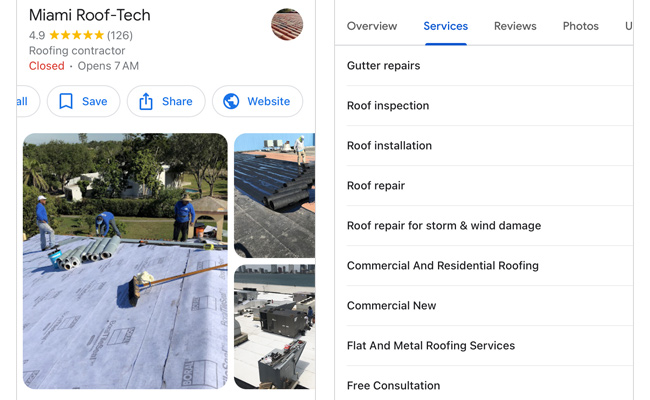
First and foremost, if you haven’t already, claiming your business on Google is a crucial step, given it’s the #1 search engine in the world. Signing up is free and enables you to provide essential information that potential customers can use to find and contact your company. 

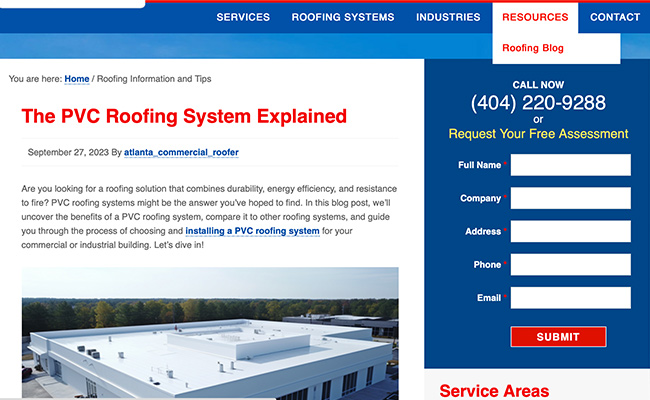
When people search for your roofing business on Google, having an optimized Google Business listing ensures your company appears prominently. Achieving a top three, first page on Google as a roofing contractor can double or triple the number of daily leads you get, according to Hayley Mace of Roofing the Villages Florida.

To get started, make sure your Google Business listing includes:

  • Your business name
  • Phone number
  • Address
  • Website
  • A concise description
  • Relevant business category
  • Your services

roofers claim your google business profile

Once claimed, you can optimize your profile and do Local SEO to propel your business to the top of Google when customers search for roofing contractors. Our marketing team can help if you don’t know how to accomplish this.

2. Start a Referral Program

In today’s digital age, word-of-mouth advertising remains powerful. To harness its potential, create a referral program encouraging satisfied customers to spread the word about your exceptional roofing services. To make your referral program effective, follow these steps:

  • Make it easy for homeowners to understand.
  • Create a dedicated webpage on your website explaining the referral process.
  • Encourage satisfied customers to provide feedback, reviews, or testimonials.
  • Promote positive feedback in emails, social media posts, and web pages.

By offering top-quality service and showcasing positive feedback, you give customers compelling reasons to refer your roofing business when their friends or family are in need.

3. Answer Your Customers’ Questions with Content

Your website content strategy plays a pivotal role in marketing your roofing company. Relevant content your customers need to know can add hundreds or thousands more monthly visitors, according to Austin Ewing of Atlanta Commercial Roofing Contractors.

Create a blog or FAQ page that comprehensively addresses your customers’ commonly asked inquiries, leaving no stone unturned. For instance, if someone asks, “What’s the average price of a roof?” you can provide a detailed answer. Tailor your content to address questions such as:

  • Which roofing materials are best for my home?
  • Should I repair or replace my roof?
  • How can I maximize my insurance claim?

start a roofing blog with content customers ask

To determine many of their questions and capture customers’ attention, use free keyword research tools to identify phrases and keywords they might use when searching for roofing services. Useful keyword research tools include:

  • Google Keyword Planner
  • Moz’s Keyword Explorer
  • Ahrefs
  • SEMRush
  • Long Tail Pro
  • Keyword Spy
  • KWFinder

Incorporate these keywords naturally into lengthy, informative blog posts and articles. Offer valuable insights to keep your audience coming back for more roofing-related information.

Following these roofing marketing strategies can enhance your company’s visibility, reputation, and, ultimately, your success in the roofing business.

4. Organize a Monthly Email Marketing Campaign

Don’t underestimate the power of email marketing for your roofing business. Many customers and potential clients check their emails regularly and appreciate staying updated on offers, tips, and industry information. 

Email marketing provides an excellent opportunity to connect with your audience, build trust, and yield one of the highest ROIs in digital marketing due to its low cost. To start:

  • Focus on collecting email addresses from your client list.
  • Offer incentives like small discounts or free guides to encourage sign-ups.
  • Commit to sending at least one monthly email newsletter.

However, executing email blasts requires finesse. Sending generic emails to all your subscribers can be ineffective and yield a negative ROI. Instead, tailor your emails based on subscriber behavior for a personalized touch. 

This strategy consistently boosts sales for roofing companies across the U.S. The connections you forge through email marketing can help you convert leads into loyal customers, establishing your business as a trusted industry authority.

5. Direct Mail Flyers and Postcards for Seasonal and Weather-Related Promotions

Roofing businesses often experience seasonal variations in demand, and using print media, such as flyers and postcards, you can leverage and piggyback on the seasonal weather patterns in your advertisement campaigns.

For example, showcase photos of roof damage caused by hail and storms during storm season to entice homeowners to prepare for the upcoming season by hiring your roofing company.

Mailed postcards and door flyers can be an economical way to spread the word about your new roofing business in local neighborhoods. This cost-effective advertising won’t strain your budget as you attract new customers.

roofing company flyer roofers use direct mail marketing

We suggest Atlanta print shop – clashgraphics.com for this type of printing and direct mail, allowing you to target specific locations or neighborhoods where you’ve recently completed projects.

6. Explore Different Marketing Channels and Platforms

Marketing channels vary in purpose, pricing, contract terms, and impact. To determine the most effective channels for your roofing marketing strategy, consider the following factors:

  • Impressions (how many people see your content)
  • Long-term and short-term Return on Investment (ROI)
  • Cost & Contract terms (one-time charge or monthly subscription)
  • Leads produced (converted sales or appointments)
  • Time required for management (business or owner involvement)
  • Effectiveness for roofers on average

Consider using the following marketing channels and service provider advertising platforms:

  • Google Ads
  • Facebook
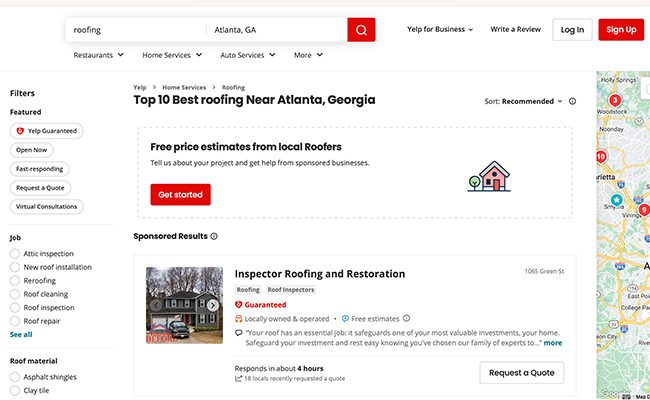
  • Yelp
  • Angi
  • Thumbtack
  • Door knocking
  • Direct mail

online marketing advertising platforms for roofers and roofing companies

Each above advertising platform produces different results. However, they all rely on your business having an outstanding reputation. In the modern marketing era, customer reviews and public opinion on your company are critical, as online reputation and branding have become business priorities.

Each of the above platforms effectively generates new leads, but consider the factors most important to your business and allocate your marketing resources most effectively.

Final Thoughts on Roofer Marketing

Marketing your roofing business can be overwhelming due to the plethora of options and lack of certainty about what will work. The effectiveness of each strategy depends on factors such as your brand reputation, location, and experience. To make the right choices, it’s crucial to understand the ins and outs of all available marketing options to the roofing industry.

Additionally, researching your competitors’ strategies can provide valuable insights into what works in your specific market. If you need assistance optimizing your roofing company’s marketing strategy, don’t hesitate to contact us at Web Consulting & Marketing. We specialize in helping roofing businesses like yours succeed in today’s competitive landscape.

How One Website Improvement Helped This Salon Furniture Company

It is very common for entrepreneurs and businesses to obsess and focus solely on website design; however, we encourage an equal emphasis be placed on its performance and user experience. These critical factors are often overlooked, but have a significant impact on the success of a marketing campaign and subsequent earning potential.

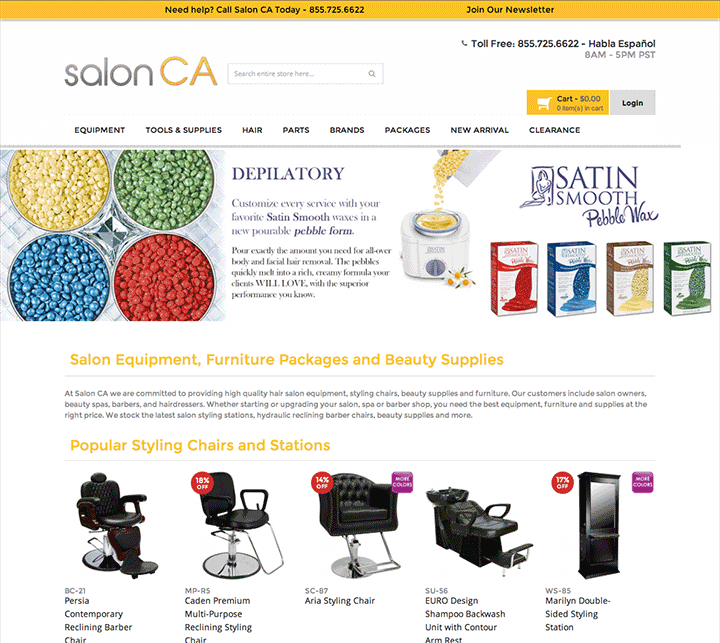
Salon equipment supplier, Salon CA came to us for a website design, but had a usability and experience problem that needed resolving.

Culture Influences Your Customers Expectations

The fast paced lifestyle of many Americans has created a customer expectation that demands instantaneous results. Technological advances such as push-start car ignition and LTE connectivity speak to the instant gratification mindset. Modern solutions encourage and facilitate this pace, which lead to an impatient customer that expects convenience and speed. Online sales of your business will suffer if your website speed lags in the slightest bit.

In this post, we will explain the process of analyzing and implementing a solution to the website speed issue that was impeding the bottom line of Salon CA.

Identifying a Problem

salonca website screenshot

Following the launch of their newly designed site, Salon CA initiated a brand new Pay-Per-Click marketing campaign. The goal was simple – sell more of their affordably priced salon supplies and furniture. Salon CA has a large inventory of equipment, so it took a few weeks to add all of their products to the Ad network and be promoted across the Internet.

However, after 3 weeks there was a very noticeable increase in website traffic. Great news, right! Well not completely…

Every business owner understands and wants more eyeballs on their website. However, the larger goal is that these visitors turn into paying customers. And despite the spike in traffic, conversions and actual sales were only marginally better.

Analyzing this Conversion Problem

We had an idea as to the source of this problem, but needed to look under the hood to confirm our suspicion. We performed an audit of the Salon CA website traffic by studying the browsing behaviors of their website visitors.

These potential customers were being attracted and driven to the site primarily by the Google Shopping network. The Google users typed a query (example – barber chair) and were shown images of barber chairs from several different vendors. Below the barber chair product images were the price and business name. Thus, the behavior of this customer was that of someone looking for a company with the product they needed, at the right price, and with a company policy they were comfortable buying from.

The visitors that saw the factors that made them comfortable clicked the “Add to Cart” or “Buy” buttons. We saw in the analytics that website users were leaving the site or abandoning the cart before finishing their transaction.

Online Consumer Psychology

Once the website data showed that online visitors were seeing the various supplies and salon equipment, but were “leaking” out of the page before completing orders, we knew the culprit was related to one of these two reasons:

1. Price
2. User experience

Every buyer has to know the price range of a product that they are willing to pay. There are several pricing strategies that can encourage buyers to take action, but that’s not the only consideration of a buyer.

User experience can be broken down into several bite-size pieces, some of which include a retailer’s refund policy, the prestige of owning a brand’s product, or the actual process of making the transaction.

All buyers consciously and unconsciously consider these factors when shopping and “interviewing” the retailer they will choose to satisfy their product fulfillment needs.

Synthesis of the Facts

Understanding this information, we knew that if customers were coming to the site after having a preview of price, then it was likely in line with what they were willing to pay. With that off the list as the issue, our focus went to the other conversion factor.

When evaluating the “experience” aspect of the Salon CA website, we looked to the main technical factor that affects the entire website: the hosting server. The Virtual Private Server that hosted their 3000 SKU product line of furniture and equipment was hosted on the Bluehost network.

In many situations, Bluehost is an ideal and very reliable hosting solution; however, after testing the Salon CA website environment, we learned the hosting server response and load times were less than desirable. This aspect was potentially driving customers away due to a poor shopping experience.

The Potential Conversion Solution

The Salon CA website was built on the widely popular Magento platform. This e-commerce application is a great product that is used by top brands and enterprise level companies. It is extremely robust; however, Magento is a known resource hog. Our page-load auditing was showing load times of nearly 5 seconds. In a culture where decisions are made quickly, every second counts.

The load speed problem was not due to their hardware or technical limitations; it was in lacking human capital. The Bluehost Virtual Private Server was unmanaged and had not been optimized in any way. We optimized the website, files, and database with HTTP headers, caching and other speed improvement; however, without a network administrator, their Bluehost VPS was nearly out the box without any optimization.

We communicated the issue and began looking for a managed hosting environment. After looking at the array of web hosts, we stumbled on a Magento optimized managed hosting solution named Nexcess. All technical requirements were met and reviews of other webmasters gave us the confidence to present this as the solution to the problem.

Interviewing and Engaging Nexcess

Next, we coordinated a call with the Nexcess sales team to address technical questions and concerns. The Nexcess representatives were very polite, knowledgeable, and seemingly a good fit for our needs.

We were provided the link to a Demo Magento website that was being hosted on their managed and optimized Magento hosting environment. The speed of browsing their Demo website was noticeably fast. Most importantly, the “Add to Cart” and checkout function performed exceptionally well also. We were seeing 2-3 second load times on average, and compared to the original Salon CA 5 second load time, this met our needs.

We confirmed with Salon CA that Nexcess was our choice provider and solution to their website issue. Included in the Nexcess plan was Email Hosting, Redis Cache, Free Migration, and SSL, amongst other perks. The plan totaled around $80 a month for 125 GB bandwidth, and included free backups and other security features.

Website Migration to Magento Optimized Nexcess Server

Once signed up, we provided the Nexcess development team the necessary credentials and they went to work. Their team backed up the current website, database, and all files. Once transferred to the Nexcess server, we were allowed to test the site in the new hosting environment. After 2-3 weeks of testing and SSL setup, the new Salon CA website went live.

The New Solution and Conversion Improvements

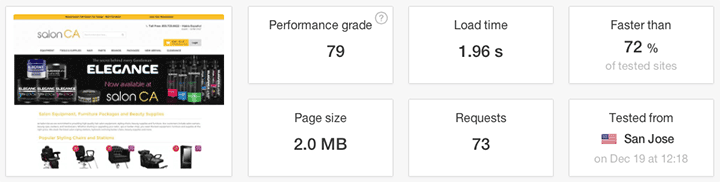
As soon as the DNS propagated and the Salon CA website loaded from the new host, we immediately saw the speed and user experience improvement. Now with less than 2 second load website load times, it was time to put the new solution to the test.

salonca website speed performance

We resumed PPC ads on the Google Shopping network, inviting traffic and customers to the new website. The moment we all waited for – was this the answer to the problem – was here.

Per the new analytics, traffic to the site was increased with our upgraded experience. The Number of Pages Per Visit increased which let us know visitors appreciated the speed improvement and were compelled to visit more pages / products. Our Quality Score also improved, which meant better Ad placement, cheaper Cost Per Acquisition, and reduced Cost Per Click (Ad Spend), resulting in greater profitability and revenue. Last but not least, conversion rate exploded 580%.

The proof was evident: faster website load speed was the solution to better conversions. Potential customers became actual customers and rewarded Salon CA for improving their user experience.

Find Salon CA on G+ or Facebook, and visit the faster and improved Salon CA website.

New Design for Atlanta Printing Company

Clash Graphics is a Graphic and Printing Company in Atlanta that serves consumers, large corporations, faith-based institutions and non-profit organizations. Over the past 5 years they have become one of the leaders in design and Atlanta flyer printing services. They print menus for restaurants, posters and flyers for concerts, and business cards for small and large companies nationwide. We were asked to optimize an existing web page so that it would convert better. Here is what we considered and did to achieve a better converting web page…

Clash Graphics Analysis

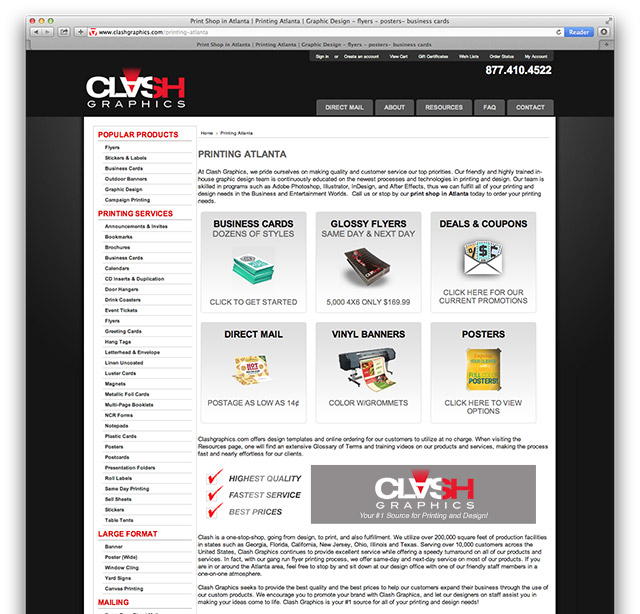
The original web page was completely filled with content but lacked visuals. When customers visited the page they were given lots of text but no clear direction or presentation of solutions and products. The benefits that Clash offered were “highest quality, fastest service, and best prices”. However, this statement was located near the bottom of the page. Since most customers were not looking to read all of the text on the page, they most likely did not scroll down and missed the main benefits Clash offered.

After thinking through it all, our first priority for the revamped design was to add visual elements that represented the products and solutions Clash offered. We produced a mockup using elements from their homepage to give them an idea of the new direction. Here is the proof and direction for the new layout that was sent:

Printing Atlanta Mockup

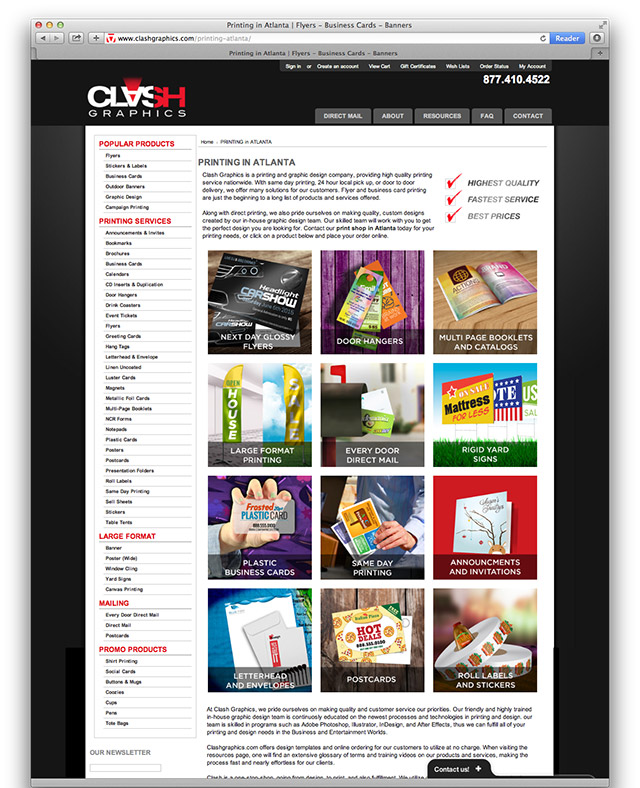
Once we received approval we began designing custom buttons representative of each product/solution. Next we wanted to bring more attention to the benefit statement and highlight it, so it was moved above the fold. Lastly, we incorporated more keywords that were relevant to their solutions so customers could find them as they searched online. Here is the final design:

Printing Atlanta Mockup

Atlanta Physician is Revolutionizing Medicine and Leveraging the Power of the Internet to Improve Lives

A longtime client referred Dr. Dana Piccirillo to us for help with his website and to grow his Medical practice. Admittedly, his mission to introduce a revolutionary approach to health and medicine is what caught our attention.

“More Drugs is not the Answer,” was the slogan that the Doctor used to convey his overarching philosophy. He explained, “Without knowing what you’re putting in your body, I’m at a disadvantage to get you well. Thus knowing what’s in your body, and how your body will react to it is important information.”

So first he tests patients for food, medical, and environmental allergies. This was the first nugget we needed – as his patients would be looking for an allergist in Atlanta. Knowing this information gave us a solid starting point to build a strategy around.

We began researching allergy testing, but continued learning more about his unique approach. Next we discovered as a result of removing certain foods and controlling toxins entering the body, his patients would greatly limit disease and lose weight, which was the second key takeaway.

He went further and explained how new DNA and Genetics testing helped him have a complete picture of his patients makeup and medical background. From there he then knows the best treatments and solutions to prescribe to get his patients well, without relying on drugs.

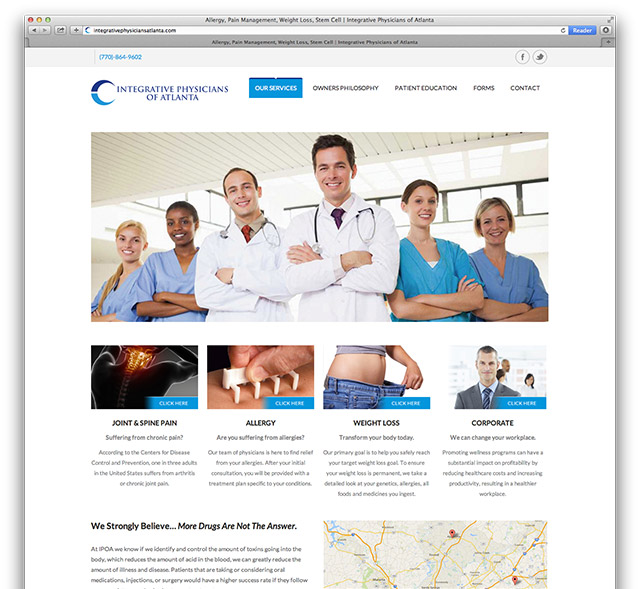
There’s more, but allergy and weight loss had a large enough demand in Atlanta for us to focus here initially. So we redesigned the website, tweaked his old content, and added new optimized pages. Patients struggling with allergy and weight gain symptoms began finding Integrative Physicians of Atlanta easily. Now More patients are finding his practice, and he’s able to help more people live healthier lives.

Dr. Piccirillo’s approach to medicine is rooted in common sense and focused on living a healthier lifestyle as opposed to writing you a ton of prescriptions. This holistic approach will appeal to a large population, and fortunately Dr. Piccirillo recognized the power of the internet to deliver his compelling message “More Drugs Are Not the Answer.”

See the redesigned website below and visit Integrative Physicians of Atlanta to learn more about his revolutionary approach to medicine.

Atlanta Allergist

 
Send us a message at info@webconsultingandmarketing.com or call us at 404-926-6650 to schedule your free Marketing consultation.

Is Your Local Business Invisible Online? Discover Local Buzz! [Infographic]

More and more consumers are using the Internet to search for products and services in their area. Sadly, local businesses are struggling to keep up with the trend. They are finding it more and more difficult to stay visible to potential customers online.

On the other hand, a select few local businesses are thriving. They are dominating local listings and enticing prospects to come and visit the shop. Want to dominate your local area for your products and services, too? Discover how you can thrive locally with the help of optimized local listings, customer ratings and reviews, check-ins, and maps – otherwise known as “local buzz.”

See our Infographic:

infographics

Local Search and Why It’s Growing

Many local business owners are aware that nearly 8 in 10 consumers use the Internet to look for products and services online. Google, of course, is the leading search engine of choice. That’s why business owners spend majority of the budget on having a website and optimizing it for search results. What many owners are realizing now is that they should optimize their online presence based on location too, not just on products and services they offer. That’s what local buzz is all about.

Local search happens when prospects type in geographic keywords in their search queries (i.e. “best wedding gowns san francisco” or “website design in chicago). Some 54% of searchers include a local modifier (city, zip code) in their search nowadays.

Much of the popularity of local search can be correlated to the growth of mobile device ownership and usage. Some 74% of smartphone owners get real-time location-based information through their phone, as of February 2012, up from 55% in May 2011, comScore said.

Local Buzz Means Money for the Biz

For now, it is clear that consumers are online and they are looking for a local business with the help of the Internet. But why should you care? In essence, it’s about your bottom line, your sales. It’s about your business’ future. Local searches are not just aimed at locating a business. They are also geared to make a purchase! As mentioned above, mobile is fuelling local search. So it is no surprise that:

  • 78% of mobile phone searches resulted in a purchase
  • 77% of tablet searches resulted in a purchase
  • 73% of mobile searches trigger other additional action and conversions

Local searchers therefore aren’t just typing queries on Google using their mobile devices; they are looking to buy! Now this is what matters: is your local business “buzzing” on local listings and consumer feedback? Or is it invisible when prospects search online?

Local Buzz 101: Beyond Traditional SEO

Typically, business owners hire a designer to create a website and then employ an agency to optimize that site. There is nothing wrong with this approach. In fact, these two things should be first in your priority. They ensure your business is present online. But your local business needs more than just exposure on general search results. It needs to be visible in various local listings and entice prospects to visit your shop and avail of your products and services. That’s where local buzz comes in.

Unlike typical and traditional search optimization, “local buzz” focuses on your business’s local online presence. This is done by combining traditional SEO with the optimization of genuine consumer reviews, check-ins, maps, and local listings. This also means that aside from your own web pages, search results from Google maps, Foursquare, independent reviews sites, and local listings will come up when prospects search online. Local buzz aims to make your local business visible and appealing to local searchers.

Dominate Local: Check-ins, Listings, Maps, Reviews

Various studies have shown that local listings, maps, reviews, and check-ins not only dominate local search results, they also influence a user’s purchase decision. For example, a BrightLocal study found that the effect of online reviews of consumers is also stronger this year, compared to last year.

  • 85% of consumers read online reviews for local businesses (up from 76% in 2012)
  • 79% of consumers trust online reviews as much as personal recommendations (up from 72%)
  • 73% of consumers trust a business more because of reviews (up from 58%)
  • 65% of consumers are more likely to use a business with positive reviews (up from 52%)

Aside from reviews, geo-social or check-ins websites and apps should be part of the strategy. Foursquare alone has 40 million users and has logged 3.54 billion online check-ins so far. You may use check-in promotions to entice prospects to visit your local store or shop. Rewarding them after a number of check-ins is one type of promotion.

Maps and listings also matter. For instance, 35% of mobile phone users who search for local businesses via apps use Google Maps, according to comScore. Meanwhile, 76% of searches using Internet yellow pages resulted in either a purchase or intent to purchase, says the Local Search Association.

The message these statistics bring is clear: you need to dominate local listings with location-based services to ensure prospects find you, and that they find you worth dealing with. Your local business needs local buzz.

Send us an email at info@webconsultingandmarketing.com or call us at 404-926-6650 now to schedule your free in-depth consultation with us. We can help your business dominate online locally with the power of local buzz.

[Video] Customers Are Searching for Local Businesses Online – and How Your Business Can Survive the Shift

Do you still think that a listing on the yellow pages is enough for prospects to find your local business? If so, this is a wake-up call.

The truth is this: paying customers are finding more and more ways to research products and services in their area. Widespread Internet access and mobile devices enable customers to find what they need instantly, on the go, and with high buying intent. This also comes with the high propensity to share experiences online with friends. If your business is not capitalizing on this shift, then you are losing out.
[Read more…]

Beyond Local Online Presence: How Your Local Business Can Keep the Cash Register Ringing with ‘Local Buzz’

According to statistics, an overwhelming 78% of consumers research about products and services on the Internet before buying locally. The message consumers are sending local business owners is therefore clear: be visible online or get ready to close shop.
[Read more…]

Responsive Web Design: Prevent Potential Sales Loss with a Mobile Friendly Website

Many business owners today tend to ignore the importance of having a mobile friendly or “responsive” website. Without realizing it, they may be losing prospective leads and sales because their website is not designed to load properly on mobile devices such as laptops, tablets, and smartphones. Here’s why you should not be one of them, and how you can make your website responsive:

[Read more…]

Responsive Web Design: How Businesses Risk Losing Customers by Ignoring Google’s Recommended Mobile Friendly Configuration

Mobile Internet users are expected to outnumber desktop users by next year. It is therefore no surprise that Google is paying close attention to this development. And so should you. Because if your website is not yet “mobile responsive,” you may be turning away prospects who browse your web pages via smartphones, tablets, or laptops. And frankly, mobile users are prospects you wouldn’t want to lose.

[Read more…]

Next Page »
  • Home
  • Web Consulting Services
  • Contact

Copyright © 2016 WebConsultingAndMarketing.com · an Atlanta Web Consulting Company · Ph: (404) 926-6650